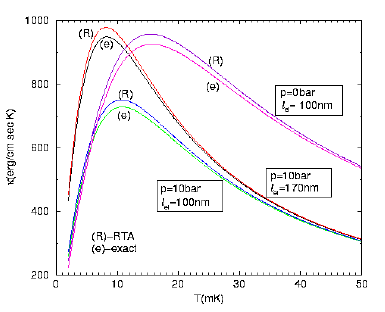
We consider the combined effects of elastic and inelastic scattering on the transport properties of normal 3He in aerogel. We report calculations of the transport coefficients for normal 3He in aerogel including both inelastic scattering of quasiparticles and elastic scattering by the aerogel within the homogenous scattering model (HSM) [1]. This model neglects the microscopic void-structure of the aerogel, which is known to affect Tc; however, the transport properties are more sensitive to the mean free path of 3He quasiparticles in aerogel and hence are expected to be reasonably well accounted for in the framework of the HSM [2].
The static transport coefficients exhibit cross-over behaviour governed by the dominant scattering mechanism; the rate scales as 1/t µ T2 for T >> T* and 1/t µ constant for T << T*. For 98% porosity the cross-over temperature is estimated to be T* » 16 mK at p = 15 bar [2]. Since the bulk transport properties of 3He are well understood, measurements of the transport coefficients for 3He in aerogel provide new information on the transport mean free path of 3He quasiparticles scattering off the aerogel structure.
The transport coefficients are calculated from solutions of the linearized Boltzmann-Landau transport equation for the steady state, with the collision integral determined by binary scattering of quasiparticles and elastic scattering off the aerogel. In the case of bulk 3He exact solutions to the transport equation were found by Brooker and Sykes [3] and by Jensen, Smith and Wilkins [4]. Solutions to the Boltzmann equation for purely elastic scattering yield well-known results for the transport coefficients which are described by temperature independent mean free paths.
In the more general case the collision integral is the sum of elastic and inelastic contributions. An exact solution is obtained by analysis that closely follows that of Refs. [3, 4] for bulk 3He. The thermal conductivity is given by
| (1) |
Numerical evaluation of the exact solution for the thermal conductivity is shown in Fig. 1 for two pressures and two aerogel models defined by their elastic mean free paths. The thermal conductivity clearly exhibits a cross-over from inelastic scattering at high temperatures to elastic scattering at low temperatures. The cross-over temperature shifts to lower temperature with increasing pressure. Similar cross-over behaviour is obtained for the viscosity, h (Fig. 2).
Our results for the thermal conductivity can be used to infer the elastic mean free paths from measured transport coefficents. For example, recent experimental results by Barker et.al [7] for the thermal conductivity of 3He in 98% aerogel yield a value for k of 7.2 mW/mK at p = 32.4 bar and 2.2 mK, which corresponds to an elastic mean free path lel = 2500 Å.
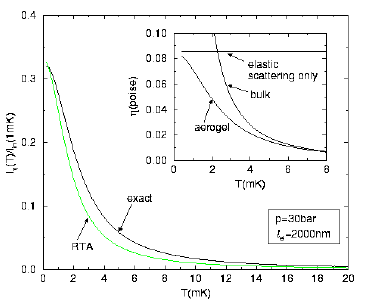
We have also compared the viscous mean free path calculated from our exact solutions, lh with that calculated within a relaxation time approximation (RTA) for the collision integral [8]. The deviations are of the order of 30% at T = 4 mK and are largest at low pressures and for low porosity aerogels.