The properties of the heavy Fermion superconductors (e.g. CeCu2Si2, UBe13, UPt3) have led to a broad effort to understand superconductors with an unconventional order parameter (we use this term to mean an order parameter which has a smaller rotational symmetry group than that of the normal metallic crystal).[2, 3] One important area involves studies of the upper critical field, Hc2, that separates the normal metallic state from the Abrikosov state of a type II superconductor, and which can play a key role in determining the nature of the underlying order parameter [4,5]. In this paper we present a theoretical explanation of the unusual temperature-dependent anisotropy of Hc2 reported by Shivaram, et al.[1] for single crystals of UPt3, which we argue provides strong support for unconventional odd-parity pairing. Theoretical arguments have been put forth by many authors (see e.g.[2]) that the order parameter for UPt3 transforms according to one of the non-identity representations of the hexagonal point group D6h. These arguments are based in part on interpretations of the observed power-law temperature dependences of the ultrasonic attenuation, and also on RPA-like models of the pairing interaction. Authors [6, 7,8] have argued that exchange of AFM spin fluctuations suppresses pairing in the odd-parity and the even-parity identity representations, but favors an even-parity non-identity representation for the order parameter. More recent variants of the AFM exchange model [9] yield odd-parity superconductivity. However, these arguments are based on models of the pairing interaction that are not grounded in a first-principles theory for the pairing instability [3]. Likewise, the interpretation of the power-law behavior of the ultrasound attenuation in terms of an unconventional order parameter is based on an assumed identification with the excitation gap, not a fundamental relationship. Therefore, considerable theoretical effort has been devoted to identifying strong tests of the symmetry of the order parameter (see e.g. [3]), including the anisotropy of dHc2/dT |Tc for tetragonal and cubic symmetry [4], as well as tests of broken time-reversal symmetry [10,11]. As yet there are no reports of positive identifications of unconventional superconductivity based on strong tests of broken symmetry. We have considerable confidence in the predictions of the BCS theory, even for unconventional pairing (e.g. 3He), provided we know the relevant material parameters like Tc, the Fermi velocity, etc., and most importantly the symmetry class of the pairing state. Thus, predictions of the BCS theory that are qualitatively different for order parameters belonging to different symmetry classes are reasonably strong tests of unconventional pairing. The loophole here is whether or not one has identified all the relevant input material parameters. Nevertheless, there is increasing evidence that UPt3 has an order parameter belonging to a non-identity representation. The strongest evidence so far comes from observations of multiple superconducting phases in UPt3 (see [12] and references therein), which are naturally interpreted in terms of an order parameter belonging to a fundamental representation with dimensionality d > 1. The double transition in zero field [13], as well as the observed kinks in Hc2^ (we use ^ and || to refer to H ^ and H || to the sixfold axis) and Hc1 [14], have been interpreted in terms of a weak breaking of the hexagonal symmetry which splits the transition into a 2D representation into two nearly degenerate 1D representations [15,16, 17,18]. The existence of multiple superconducting states suggests that the order parameter belongs to one of the 2D representations: even-parity E1g or E2g, or odd-parity E1u or E2u.
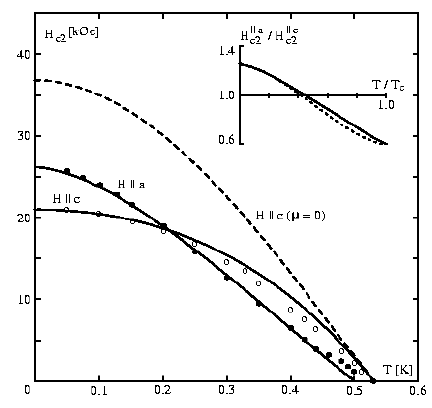
Although attention has recently been focussed on the Ginzburg-Landau region, where anomalies in Hc2 ^(T) have been observed, the low-temperature measurements of Hc2 ^ and Hc2|| contain an important clue to the identification of the order parameter. While measurements of the parallel critical field are considerably larger than those measured in the basal plane for T > 200 mK, Shivaram, et al. [1] found that Hc2| | was strongly suppressed relative to Hc2 ^ below ~ 200 mK. A plot of the anisotropy ratio from, [1] R(T) = Hc2 ^/Hc2| | (inset of Fig. 1) crosses unity at T @ 200 mK from R(Tc) @ 0.6 to R(T® 0) @ 1.25. This crossover in the anisotropy ratio is a unique feature of UPt3 that has so far not been explained by BCS theory, even with an unconventional order parameter, but is qualitatively and quantitatively accounted for within BCS theory if: (i) the uniaxial anisotropy of the Fermi surface is included, (ii) the paramagnetic coupling to the field is included, and (iii) the order parameter belongs to one of the following odd-parity (S = 1) representations; E1u, A1u, A2u, B1u or B2u appropriate for strong spin-orbit coupling of the Cooper pair spin to the lattice.
The Fermi surface anisotropy determines the anisotropy ratio near Tc, where the paramagnetic coupling is unimportant, while the interplay between the paramagnetic effect, strong spin-orbit coupling and the spin of the Cooper pairs for odd-parity pairing is crucial for explaining the crossover in the anisotropy ratio at low temperatures. For even-parity states, the upper critical field is bounded by the paramagnetic effect for all directions of field. But for odd-parity states, there is no paramagnetic suppression of superconductivity if the external field is perpendicular to the direction D along which the Cooper pairs have zero total spin, i.e. D ·S = 0; whereas other orientations of the magnetic field relative to D will be a pair-breaking.[19] Thus, the paramagnetic limit can have a dramatic effect on the anisotropy of Hc2 for odd-parity states with strong spin-orbit coupling, which serves to lock the Cooper pair spin to the crystal lattice.
The results presented here are based on the quasiclassical theory of superconductivity (we use the notation of Alexander, et al.[20]), which allows us to incorporate an anisotropic Fermi surface, paramagnetic coupling, spin-orbit coupling, impurity scattering and an unconventional order parameter into our calculations. The formalism and details of the calculations presented here are contained in a forthcoming article [21].
We present results for the clean limit, 1/timp << 2pTc, appropriate for high-quality single crystals of UPt3. The central equation is the linearized weak-coupling gap equation; for odd-parity (S = 1) pairing,
| ||||||||||||||||||||||||||||||||||
| Rep. | Order Parameter | hc2(0) | -Tc dhc2/dT |
| E1u | f2[^(z)]k- +c0 f0[^(z)]k+ | 0.77 | 1.08 |
| f0[^(z)]kx | 1.01/Ö{h} | 1.19/Ö{h} | |
| E2u | f0([^(x)]+i[^(y)])k+ | 0.37 | 0.59 |
| f0([^(x)]ky+[^(y)]kx) f | 0.65/Ö{h} | 0.84/Ö{h} | |
| B1u | f0[^(z)](kx3-3kxky2) f | 0.32 | 0.53 |
| f0[^(z)](kx3-3kx ky2) f | 0.92/Ö{h} | 1.07/Ö{h} | |
| E1g | f2 kz k-+c0¢f0 kz k+ | 1.15 | 1.51 |
| f0 kz kx f | 0.70/Ö{h} | 0.96/Ö{h} |
It is useful to introduce the coherence lengths, x^ = vf^/2pTc, x|| = vf||/2 pTc, and a magnetic field scale, Ho = (hc/2e)/px^2, as well as the dimensionless parameters:
| (2) |
We first consider solutions for the odd-parity 2D representations, E1u and E2u, and also the B1u representation, which for our purposes is representative of all the 1D odd-parity states. Consider the E1u order parameter (see e.g. Ref. [22]),
| (3) |
When the magnetic field is along [^(z)], the maximum value of H occurs for (h+,h-) ~ (f2,cofo).[24] Without paramagnetism, h||c2 has the limiting values shown in table I. Since the pairs have Sz = 0, the paramagnetic term reduces hc2||. Fig. 1 shows the reduction in hc2||(T) at low temperatures due to paramagnetic limiting as well as the absence of a paramagnetic effect near Tc. By contrast, hc2^ (T) is independent of the paramagnetic effect because the pairs have no amplitude with zero spin projection for directions in the basal plane.
In table I and fig. 1 we summarize the results for the E1u representation as a function of T/Tc for relevant choices of the effective mass ratio h and scaled effective moment [`(m)]. Both hc2|| and hc2^ are scaled in units of Ho; hc2|| is then independent of h, while hc2^ scales as 1/Ö{h}. As noted earlier the paramagnetic effect can significantly reduce the value of hc2|| at low temperatures, whereas it has no effect on hc2^. Thus, by adjusting h and [`(m)], we obtain hc2|| and hc2^ that crossover at an intermediate temperature. We have a crossover around 0.4 Tc for h = 3.37 and [`(m)] = 0.68; the inset of fig. 1 shows the anisotropy ratio hc2^/hc2|| as a function of T/Tc for this choice of parameters, compared with the experimental values from [1]. Fig. 1 also shows the measured values of Hc2^ and Hc2|| compared with the theoretical calculations. We have purposely chosen slightly different values for Tc of Hc2^ and Hc2||, which emphasizes the discrepancy in the narrow temperature interval of the double transition, but provides a better fit to the data away from Tc. An essentially perfect fit to the full temperature range, including the region of the double transition, can be obtained by including the splitting of the E1u representation by a weak symmetry breaking field.[15]
| ||||||||||||||||||||||||||||
There are four odd-parity, 1D representations in the limit of strong spin-orbit coupling, all of which have a similar spin structure to that of the E1u representation and, therefore, exhibit similar anisotropic paramagnetic effects. We choose B1u to illustrate the 1D representations with D(kf,R) = j(R) [^(z)] f(kf). A numerical calculation of the anisotropy ratio hc2^/hc2|| for h = 11.0 and [`(m)] = 1.2 gives an almost identical fit to the experimental data of UPt3 as that shown in Fig. 1 for the E1u representation. Similar results can be obtained for all of the 1D odd-parity representations with suitable choices of the anisotropy and paramagnetic parameters.
The important distinction of the even-parity states is that the paramagnetic term is important for any direction of the magnetic field. For the E1g representation,
| (5) |
We have calculated the upper critical field for order parameters belonging to the even- and odd-parity representations of the hexagonal point group with strong spin-orbit coupling. The effects of paramagnetism and anisotropy of Fermi surface on the anisotropy of the upper critical field, in particular the crossover behavior of hc2^/hc2||, were examined in detail. For odd-parity states E1u and B1u, with a D parallel to [^z], the anisotropy ratio hc2^ / hc2|| fits the data on UPt3 well with two parameters that measure the Fermi surface anisotropy and the paramagnetic effect. Although our model for the Fermi surface anisotropy is simple, we note for comparison that the values, h = 3.37 (11.0), Ho = 4.8T (9.4T) and [`(m)] = 0.7 (1.2), which we obtain from our fit for the E1u (B1u) representation, imply an effective moment of m = 0.34 mB (m = 0.30mB), in reasonable agreement with several other estimates [25]. The important point is that the Fermi surface anisotropy and paramagnetic coupling give rise to a crossover in the anisotropy ratio of the right magnitude and temperature dependence for realistic values of the material parameters only for odd-parity states with D along the [^z]-axis. In particular, for the E2u representation (D^[^(z)]), the paramagnetic term affects only hc2^, and not hc2||, and thus cannot account for the observed crossover. For even-parity states, the paramagnetic effect suppresses both hc2^ and hc2||, and even tends to reduce the anisotropy of upper critical field at low temperatures. These characteristics lead us to conclude that the experimental data of Ref. [1] provide strong support for odd-parity pairing in UPt3.
We thank D. Rainer, M. Graf, and G. H. Kim for many useful discussions. The research of C.H.C. was supported by the NSF through the Northwestern University Materials Research Center grant no. DMR-8821571, and that of J.A.S. was supported by the NSF (DMR-8809854) through the Science and Technology Center for Superconductivity.
Note added 10/31/90: An independent test of the proposed model for the order parameter in UPt3 is the spin-susceptibility anisotropy (from Knight shift measurements) D||[^(z)]. The spin susceptibility for H||[^(z)] should be reduced, similar to that in conventional superconductors, while the spin susceptibility perpendicular to the [^(z)] axis should be essentially independent of temperature.