If
the Math Symbols in the HTML documents are garbled a quick fix can be found
here: Font
Fix
Proceedings of LT22, Helsinki (1999).
Acoustic Faraday Effect in Superfluid 3He-B
Y. Lee, T.M. Haard, J.A. Sauls, and W.P. Halperin
Department of Physics and Astronomy, Northwestern University,
Evanston, IL 60208, USA
Abstract
We have observed that the direction of linearly polarized transverse sound
in superfluid 3He-B rotates in a magnetic field. This acoustic
Faraday effect proves the existence of a propagating transverse sound mode
in 3He and provides clear evidence for spontaneously broken
relative spin-orbit symmetry.
The existence of transverse sound in liquids is highly unusual since
they do not, in general, support shear and consequently there is no restoring
force to sustain a transverse wave. Nonetheless, in the special circumstances
of liquid 3He, a restoring force can be provided by the collective
interactions of the liquid as was predicted by Landau in his seminal work
on Fermi liquids [1].
Our observation [2]
of the acoustic Faraday effect proves the existence of this mode in 3He
and provides an intuitive demonstration of broken relative spin-orbit symmetry
in the superfluid B-phase.
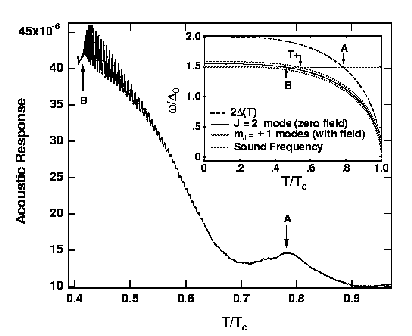
Figure 1: Temperature dependence of acoustic response at H = 0 and P
= 4.31 bar. Inset, Cooper pair energy, 2D(T),
the sound frequency, and the imaginary squashing mode, J = 2. The zero
field crossing points are labled A and B. For nonzero field, T+,
is the crossing of sound with the mJ = +1 substate.
We formed an acoustic cavity with two quartz transducers of 6.3 mm diameter,
their ground planes face-to-face and a spacing between the transducers
of 31 mm. One of the cavity walls was a 12 MHz,
AC-cut transducer used for transverse sound excitation and detection. All
transverse sound measurements were performed at 82.26 MHz, the 7th
harmonic of the transducer. Our detection method for transverse sound was
based on measurement of the acoustic impedance of the transducer using
a frequency-modulated cw-bridge, spectrometer. [3]
In a highly attenuating regime, where there is no reflected wave, the acoustic
impedance is simply the bulk characteristic acoustic impedance, Za
= rw/q where r is
the density of the liquid and q is the complex wave number with q = k+ia;
a
is the attenuation and k the wavenumber. If attenuation is low, then the
presence of reflected waves in the cavity modulate the acoustic signal.
As the phase velocity, Cf = w/k,
varies with temperature the acoustic impedance will oscillate, Fig. 1.
This is superimposed on a background of changing acoustic impedance characteristic
of the bulk liquid.
Early experiments to look for transverse sound in the normal state of
3He
have suffered difficulties in both experiment and interpretation [4]
and there is not yet direct evidence for this mode, although the theoretical
conditions for its existence are satisfied. The situation is quite different
in the superfluid, as was pointed by Moores and Sauls. [5]
They predicted that in 3He-B there is an off-resonant coupling
between transverse sound and the superfluid condensate via a collective
mode of the order parameter, the imaginary squashing mode. This coupling
increases the phase velocity and reduces Landau damping.
The transverse current couples to two substates of the J = 2 imaginary
squashing mode, mJ = ±1, and
these currents correspond to right- and left-circularly polarized waves
which are degenerate in zero magnetic field. The full dispersion relation
for sound is, [5]
|
æ
ç
è |
w
qvF |
ö
÷
ø |
2
|
= |
F1s
15 |
|
æ
ç
è |
rn
r |
ö
÷
ø |
+ |
2F1s
75 |
|
æ
ç
è |
rs
r |
ö
÷
ø |
|
æ
ç
è |
w2
w2-w22 |
ö
÷
ø |
|
|
(1) |
where rs(n) is the frequency dependent
density of the superconducting (normal) component (r
= rn+rs)
and F1s = 6.8 at a pressure of 4 bar. [4]
With decreasing temperature the J = 2 excited state frequency,
w2,
approaches the sound frequency, w; the phase
velocity increases producing the cavity oscillations in Fig. 1. In this
region the second term in Eq. (1) dominates until the crossing point B
where transverse sound is extinguished. In a magnetic field the Zeeman
splitting of the J = 2 state first gives a crossing of sound with the mJ
= +1 substate. Consequently, the two circular polarizations have different
phase velocities, easily calculated from the dispersion, Eq. (1), causing
the direction of linear polarization of the transverse sound to rotate,
producing an acoustic Faraday effect. This modulates the oscillatory signal
in Fig. 1 as shown in the data in Fig. 2a and the simulation in
Fig. 2b. The simulation uses values for the attenuation and velocity
measured in zero field. One adjustable parameter is the Landé g-factor
for the Zeeman splitting of the J = 2 imaginary squashing mode which we
find to be g = 0.020 ±0.002. The angle
of rotation is proportional to field consistent with theory. [5]
Details will be reported elsewhere. This work was partially supported by
the NSF grant DMR-9703575.
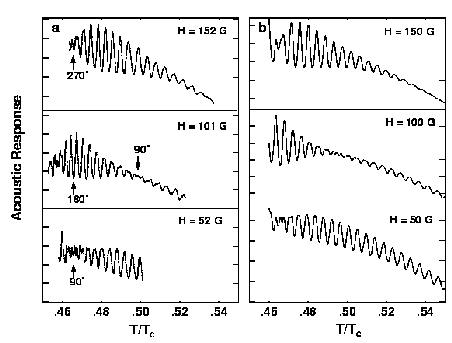
Figure 2: Measurements a and simulation b of the acoustic
amplitude
References
-
[1]
-
Landau, L. D.Sov. Phys. JETP 3, 920- (1957);5, 101-
(1957).
-
[2]
-
Lee, Y., Haard, T.M., Kycia, J.B., Sauls, J.A., and Halperin, W.P. Nature
to be published (1999).
-
[3]
-
Lee, Y. et al. J. Low Temp. Phys. 103, 265-272 (1996).
-
[4]
-
Halperin, W. P. & Varoquax, E. in Helium Three (ed. Halperin,
W. P. & Pitaevskii, L. P.) 353-522 (Elsevier, Amsterdam, 1990).
-
[5]
-
Moores, G. F. and Sauls, J. A. J. Low Temp. Phys. 91, 13-37
(1993).
File translated from TEX by TTH,
version 2.30.
On 12 Dec 1999, 18:15.